Introduction
"Don Quijote de la Mancha" foremost is a story about contrary views and different perspectives. Don Quixote has read so many romances of chivalry
(“roman” means novel in verse) that he cannot differentiate between literary and
real world anymore. In fact most comedic situations in the story arise due to
the harsh differences between reality and idealist perspective of Don Quixote. Cervantes argues that our interruption of the
world is thoroughly subjective. Regardless of the object we are looking at, our
past experiences, choices, and the decisions we have made define our perspective.
To understand what motivated Cervantes to choose this theme, I decided to
explore the history of Spain and contemporary issues during his time. This was a
time when different ideologies clash both within Europe, and between East and
West.
Iberian Peninsula
Cervantes
starts his book by claiming that he is not the author of Don Quixote. He introduces himself as a historian who has stumbled
upon this biographical account by sheer accident:
I was standing
one day in the Alcana, or marketplace, of Toledo, when a lad came up to sell
some old notebooks and other paper to a silk weaver who was there. As I am extremely
fond of reading anything, even though it be the scraps of papers in the streets,
I followed my natural inclination and took one of the books, whereupon I at
once perceived that it was written in characters which I recognized as Arabic.
I recognized them, but reading them was another thing. I began looking around to
see if there was any Spanish-speaking Moor by who would be able to read them
for me; It was not very hard to find such an interpreter (419)
Furthermore, in
chapter 22 he introduces this source as: “Cide Hamete Benegeli, the Arabic and
Manchegan author, in the course of thus most grave, high sounding, minute,
delightful and imaginative history, informs us that following the remarks that
were exchanged between the Don Quixote de la Mancha and Sancho Panza"(451).
Why does Cervantes create an Arabic historian to tell his story? During this
time Muslims and Arabs were perceived very negatively by the church and authorities
in Spain. Moors were referred to as savages who has crossed to Europe and
occupied Christian land. Between the times Cervantes wrote Part
I and II of “Don Quixote”, three-hundred thousand Moriscos were expelled from
Spain to Africa. It is important to understand the demography and history of
Spain to comprehend Cervantes criticism of mainstream ideology better.
Long before Spain comes to existence as a modern State, Greeks called that
region Ibēría. Iberia was a land that people from different part of Europe had migrated
to and were living in tribes alongside each other. It took the Romans two centuries to defeat Iberian
tribes and after their victory Romans called this region Hispania (hence the
name Hispanic people and Spain). They reigned over the region for 600 years
between 19 B.C. to the 5th century before highly Romanized Germanic Visigoths attacked
Rome and settled in Hispania.

https://en.wikipedia.org/wiki/File:Visigoth_migrations.jpg
Visigoth Kingdom (5th–8th centuries) decayed to chaos relatively soon. A Visigoth
nobleman named Julian, Count of Ceuta, wrote a letter to an African Muslim
general, Musa bin Nusayr, and told him about how people in Hispania are
suffering under the rule of new king, and that he should invade their country
and free them. This was just a plot to weaken the reign of Roderic, the new king.
Nevertheless Musa assigned the job to Tariq ibn Ziyad and send him with 7000
thousand soldiers to conquer Hispania, and so he did. These Muslims who came
from Africa and later were joined by Arabs were called Moors.
Al-Andalus (711 to 1492)
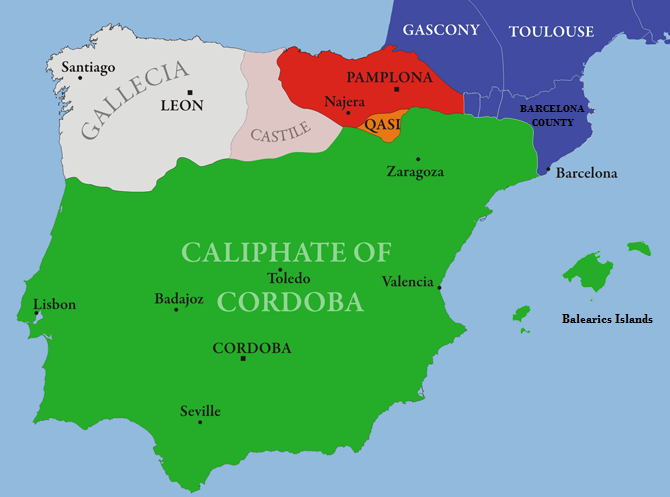
Al-Andalus and Christian kingdoms circa 1000 AD
https://en.wikipedia.org/wiki/Al-Andalus#/media/File:Al_Andalus_%26_Christian_Kingdoms.png
This is one of the places that Cervantes’s
philosophy on duality
of perspectives comes handy. There are two complete opposite beliefs about the
way Muslims governed Al-Andalus (the name Muslim gave to the region). Some
people and historians completely demonized Muslims by reciting primary sources
that claim Muslims ruthlessly killed and raped Christens, beheaded nobles, and
did not show mercy to anyone. Other historians offer romanticize version of war
and claim people welcomed Muslims with open arms and show little resistance to
their invasion. However, everyone seems to agree that Muslims renovated Spain entirely.
John Glover Jackson in his book “The Empire of the Moors” give few example of
life under Muslim rule:

People of different
faiths were allowed to live there. Non-Muslims were called dhimmi. Though
they had to pay extra taxes for the protection they were receiving. Furthermore,
they were allowed to have their own courts and judges, and they could take part
in local politics. However, their most important contribution to European society
was introduction of Paper. It was first in Toledo that Muslims brought this Chinese
technology and created the first paper mill factory in 1150. This made writing
very affordable and accessible to everyone. It is safe to assume that without
these factories Don Quixote could have quite a harder time to see the light of
the day. So it is not far-fetched to think Cervantes created Cide Hamete
Benegeli, the historian, to appreciate the role Moors played in bringing
education and these technologies to Spain.
If you are interested
to find more information about this era, I encourage you to watch this two
hours long documentary on “Al-Andalus History of Islam in Spain”:
Work Cited
John G. Jackson, “The Empire of the Moors,” in Ivan van
Sertima, ed., Golden Age of the Moor (New Brunswick: Transaction, 1991), 86
When the Moors Ruled in Europe. Dir. Timothy Copestake.
Perf. Bettany Hughes. Channel 4, 2005. Web. 14 Nov. 2015.
<https://www.youtube.com/watch?v=xtCj0NvhYyI>.

No comments:
Post a Comment